Got Denied for a Us Tourist Visa Because of No Strong Family Ties
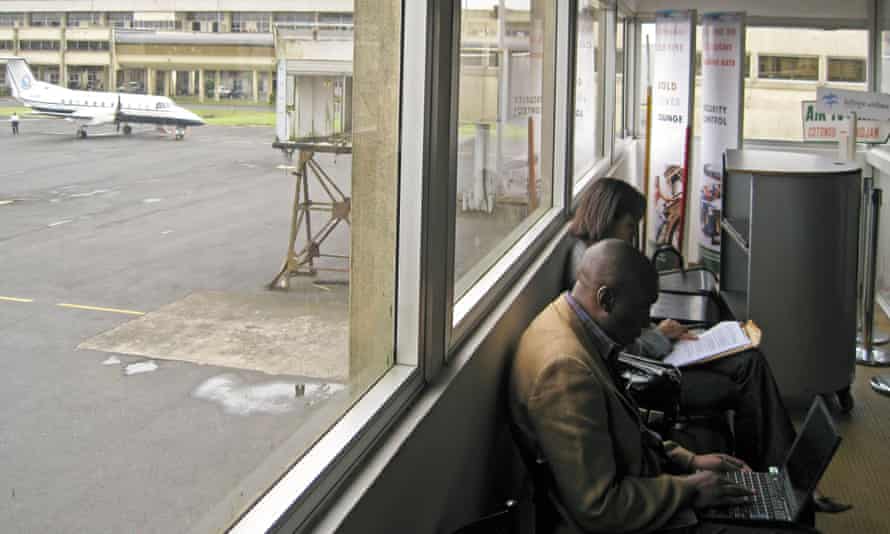
I am a western visa rejection expert. Iii times – even though I work at an airport. Only I am generally a literary pass up, a reality which also, somehow, always presents itself in sets of threes. Similar a trilogy.
I am at the United states of america embassy in Yaoundé, Cameroon's uppercase, waiting exterior the gate and the loftier fence. I adore the white tiled buildings and poles flaunting American flags. We stand up in the morning sun. A Cameroonian security guard walks towards us.
"Information technology is not nonetheless 8am. That is the time when you lot volition make it, non at present, then don't stand up here. Motility abroad please," he booms, to young people and people twice his age alike.
We mumble. He insists. The American diplomatic mission is similar some serene elephant that cannot be disturbed. The Cameroonian security baby-sit seems more protective of information technology than the Americans are. We move and stand most the fences of other embassies. Eight o'clock comes. Our grumbling assumes the sound of a propeller-powered shipping. He finally tells usa to motion forward at 8.10.
Three guards perform a manual search on our bags and we enter the embassy'southward security room. They scan our bodies with walk-through metal detectors, and our bags again, with 10-ray machines. We sit in the piazza merely outside the interview hall.
I am here to obtain a conference visa to nourish the spring session of the 2017 Art Omi international writers' residency in New York land. My application was accepted in 2016. I desire to do some introspection in a quiet environs and work on my novel. Douala, the rowdy and dysfunctional French-speaking economic upper-case letter where I alive and work, has been distracting. I'yard also keen to make literary connections and share my work with a new audience. Experiencing what life is like in another country, another city, is also on my mind. I want to acquaint myself with New York earlier possibly moving in that location to report; I have also been offered a partial scholarship to study for a writing MFA at the Pratt Found.
It is March, the calendar month of my birth. I accept been on holiday at my uncle's in the littoral city of Limbe, located in the English-speaking South-West region of Cameroon. The Douala International airport, where I work, had been shut down for three weeks so the runway could be repaired. It was an opportunity for me to discuss the payment of the balance of my fees with family. My uncle, Nkeng Ivo, the head of the family, plays a very big role in our lives, more so than my male parent in my dwelling house town of Kumba.
I had been deep in communication with my family when I received a phone call from my neighbour in Douala. My rented studio and two others had caught fire and were totally burned out. He and a couple of others had saved some of my things. My thoughts at the embassy are bittersweet.
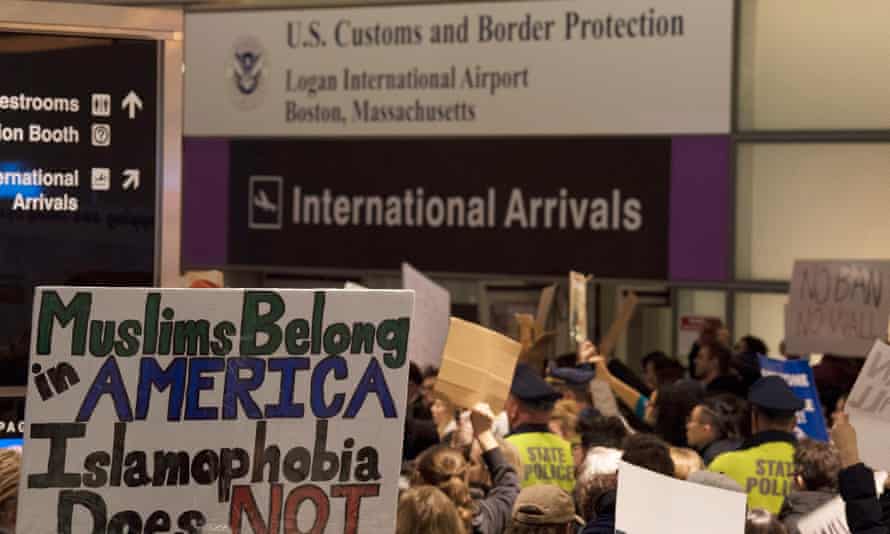
It is also the month Donald Trump implements his travel ban on half-dozen Muslim-bulk states. Two are in Africa. Cameroon is not amidst the countries blocked past his ban, and so I am optimistic. The next group of 10 visa applicants are ushered in by a guard. I am amid this set, mostly immature people hoping to obtain student visas. At that place are three interviewers in forepart of us, all lily-white. I am at the rear of the queue, and I watch them reject visa applicants i after another. A immature guy has been admitted to two The states universities, but still gets rejected. Ane boy from my queue is given a visa. His smile is then luminous it is like he'southward going straight to sky.
The rejections go along. Even a pastor is turned abroad, visaless. A adult female who has brought her sometime, ailing male parent is making a scene. He has been given a visa and she has been rejected. He is quiet. She is screaming. How will he get to the US alone? He tin can barely walk. The consular officers are unmoved past her theatrics. She won't get out the counter. A security guard appears. She walks abroad. The consular officers continue working. They don't even examine applicants' documents, equally I heard they did in the past – they but await at the admission letter or invitation to a university graduation or wedding. And so they interview the applicant and decide upon their fate, which is by and large reject, reject, refuse.
I am side by side, residency invitation in manus, other documents and published work neatly in a file. I have to stand in front of the seated consular officeholder – a slim man with geeky reading glasses – throughout my interview.
"What is the purpose of your trip to the US?"
"I'm going to attend the Art Omi international residency, sir," I say, handing him my invitation through the space in the drinking glass. He reads it diligently.
"So who is paying for your trip?"
"Fine art Omi will pay for my lodging and feeding, as it is said in the letter. I will pay for my flight."
"What do you write?"
"Fiction and creative nonfiction. I'yard a blogger, besides, and so I create online content." He types all I say. I go along. "I've brought all my published works in print with me. Short stories in a few anthologies and my children's chapbook."
I am about to give him my 2d file of published piece of work when he snaps through the microphone: "No, no, no, I don't desire to see any books." He opens his right palm towards me and shakes it vigorously from right to left and left to right, in a proceed-those-things-abroad fashion.
The gesture ruins my mood. Are my published works not the ultimate evidence? Perhaps books are too considered part of the documents that consular officers no longer examine? I am afterwards told by a friend that I should have merely informed the official that I had come with my published works, not endeavor to send them through the slot in the glass for him to see. It was forceful. He needed to ask first. But he doesn't ask for any other certificate.
"Where do you lot work?" he continues. My responses are now no more than audible whispers. I mention Douala International aerodrome.
"Take y'all travelled before?"
"Yes."
"Which country?"
Every bit I begin to say: "Republic of ghana, Rwanda and Ethiopia," he is flipping over the pages of my passport quickly, looking for the visas. Does he call up I am so impaired that I would tell that kind of stupid lie? Someone who works at an airport. And anyway, I have already filled in all the data he is asking me on the DS-160 visa application form online. He and the other consular officers have already decided upon my fate, they did so before I ready foot in here.
"Are you married?"
"No."
"Now tell me, too, do you have any kids?"
"No."
I think this is the last nail in my coffin. He may regard me as a flying risk – an ambitious immature human being without direct family ties, who volition remain in the Us. He finally hits the gavel on the table like a guess.
"Sad, our visa laws accept get very, very tight. Very tight." He lays emphasis on the "very tight", so pauses, before adding: "Y'all can travel to the United States just when … " he halts once again, and then deals the killer blow: "When you go an accomplished author." We stare into each other'south eyes. It's an icy moment.
"But you can try again next fourth dimension." He has a mournful look on his face, as if he is a concerned physician telling me about the diagnosis of a last illness in the near soothing way possible. But I go on repeating one thought in my head: y'all're an asshole, you lot're an asshole.
He hands me a green piece of newspaper.
"Delight read this carefully. You will better sympathize why your visa was rejected."
It is the same damn greenish paper they give to every rejected visa applicant. The reason they requite is the same for everybody: you take non convinced them of the reasons why you lot want to travel to the US. They don't remember y'all will return to your dwelling country. You cannot entreatment the decision. An interview costing almost $200 ends with a cold-blooded rejection in less than 10 minutes, as if it'southward a joke.
1000 y writer friends, Dzekashu and Howard, are stunned, especially at the "No, no, no, I don't desire to see any books!" Howard suggests I should write nigh the consular officer. My family is shocked. What is the reason for my rejection? Visa laws take become very tight? What rubbish is that? I paid for that interview. I deserved a physical reason.
My father, Atemnkeng Simon, my nearly gorging reader, is devastated. He consoles me and assures me some other opportunity volition come my style. My child sister in Florida, Five, tells me she isn't surprised. It is partly due to Trump's travel ban. Developing countries, especially ones with political crises similar ours, are invisible names in Trump'due south book, in improver to the six named. Our visa quota has dropped. They are observing information technology over there. Cameroonians are not travelling to the US like they used to.
During the Obama years, it had been relatively easy for my airdrome colleagues to obtain tourist visas. A few of them had travelled to the United states for holidays (and returned). I travel back to Douala, where I move into my Aunt Hilda's. I stay there for some time to sort myself out and look for a new house. Hers has occupants already, so her sitting room becomes my room, her couch my bed. Her Idiot box is merely next to my pillow. I switch to CNN one day and confirm my sis's suspicions. A headline reads: "Travel to the United states down globally by 10%".
My plans to study at the Pratt Institute besides autumn autonomously. I need at least $fifty,000 to meridian up my $11,000 scholarship. And even if I obtain the total scholarship, is information technology certain that the American diplomatic mission will grant me a student visa?
My kind Aunt Hilda and her funny neighbor, Sam, try to cheer me upwards, merely I descend into the saddest country. I express mirth at their jokes, but shed silent tears when I'yard alone. I morph into a wrapped ball of nighttime thoughts under my wrapper. Why is my life progressing and and so regressing? Why are my breakthrough moments breaking?
At piece of work, colleagues enquire me almost my burned business firm, but I don't talk about it. A few others are insensitive, making jokes almost me existence homeless. None of them even know about my visa rejection. But it is a trilogy of disappointments for me, all in the calendar month of my nascency.
I email the residency director well-nigh my visa rejection. I tell him the residency is important to me. I desire to defer until the autumn session in October, and try again at the embassy. He is shocked by my rejection, but tells me the determination isn't uncommon among artists they invite. He says the rejections put the whole concept of their international residency into question. He accepts my deferral proposal. I speculate on what he says. The Art Omi international residency could even shut down if the rejections continue.
I am back at the American diplomatic mission for my 2d interview in July – a B1/B2 tourist visa awarding, since conference visas have all been booked upward online. The human being who interviewed me final fourth dimension is on the left, a burly man is in the eye, and an old lady with white hair is on my right. She reminds me of Margaret Atwood. I motility alee in my queue. Non a single visa is given. I am side by side. The man who interviewed me final time is free, and then I walk upwards to him – I don't similar this coincidence. Of class, he doesn't call back me, but when he starts typing, my information appears on his screen. He glances at me.
"Have we met before?"
"Aye."
"Go to counter seven, delight."
I step aside and ask a guard where counter seven is. He points at the burly man in the heart. Someone is leaving the counter. I have my documents and published works with me, but he doesn't ask for any documents. I don't cartel advise showing him annihilation until he asks. He asks for my invitation letter. The questions he poses are the same as terminal time: purpose of trip, the funder, what I write. He adds another question: "How much do you earn?" When I tell him, he contorts.
"So, _____ months of your bacon volition buy you a return ticket to the Us?"
"Yeah."
He pauses in his typing.
I'm thinking: "Dude, I've been working for seven years. Plus, I didn't fall from the sky."
"Are you married?"
"No." He shakes his caput.
"Practise you accept any children?"
"No." He shakes his head more vigorously this time.
Here comes the curse of the young, unmarried male without kids. I know what'due south coming next.
"Have you travelled before?"
"Yes."
"Where?"
I repeat the countries. He listens keenly before speaking. "I'm sad, I tin't issue you a visa. It is very difficult to travel to the United States, unless yous accept travelled out of Africa earlier. On this green slice of paper you will find the reason … "
It'southward like a scene from The Terminal, the Tom Hanks movie – except that the Tom Hanks grapheme is trapped in the drome for ix months, whereas this story plays out at the American embassy in merely v minutes. I walk abroad like a man in a trance. Embassies make a lot of coin off visa applications. (In fact, Africans are estimated to lose at least $50m in rejected visa applications to the west each twelvemonth.) The default mode at the Usa embassy is: decline.
Perchance they call back I want to get to the Us, burn my Cameroonian passport and starting time seeking asylum, ally an American denizen or join the US army; all in an effort to obtain a US passport. I recollect of all the bankrupt Cameroonians I know who have told the almost blatant lies and presented the greatest fakes in the name of documents at the American embassy, and were given visas.
I think, too, of Cameroonians with strong financial muscle and bulky bank accounts, who intend to travel to the U.s. to engage in businesses, or do academic work, or to holiday and return, but have been rejected visas. I feel that sometimes the consular officers know that the person they are interviewing volition never return to Republic of cameroon, yet they however event a visa. That some other person will return, who will not get a visa. I conclude that visa issuing is a mystery that just consular officers understand.
I travel to Nigeria in Nov, equally part of the Limbe–Lagos literary exchange programme, where I am awarded the prestigious Sylt Foundation writing residency in Germany during the opening ceremony of the Aké arts and book festival in Abeokuta. But before Sylt, I had practical for a German language writing residency, the Künstlerdorf Schöppingen, three times, before finally being accepted. It is only when I receive an email from a German translator in Berlin that I empathize how: "If you had got your visa for the US last year, we would accept met at Ledig Business firm. How practice I know? Because – modest earth – I was on the board of the Schöppingen this year. I like your short story Wahala Lizard. So I promise yous bask your fourth dimension there, it's my dwelling house region … "
I smile at fate consoling me. I ship him a happy respond, thanking him for choosing me.
"You will be issued that Schengen visa," a friend assures me. "The Germans are much more open up with their visa procedure. You just demand to show enough evidence at the embassy."
I t is 8am one solar day in May 2018. I am at the German consulate in Yaoundé, a large white bungalow, to apply for a Schengen 90-24-hour interval tourist visa. The Cameroonian security guard, who is wearing an old-fashioned grandaddy suit, is more than abrasive than all of those at the American embassy put together. My friend Dzekashu, who has also been here for an interview, jokes: "If that security guard had been a consular officeholder, he would not grant everyone a visa."
The morning sun seethes on our heads. The guard leaves us sitting in its glow, not on seats, but on some former cement slabs and railings exterior the building. At least it's meliorate than standing in the sun in front of the US embassy. I turn to the young boy sitting beside me.
"When those in the due west want to travel here, do they go through all of this stress?" He giggles. I tell him most being chased away from the gate of the American embassy. He widens his optics in shock.
"That'due south crazy! These Europeans, they probably just purchase their flight tickets and board planes straight to Africa. No embassy."
I smile and say they need visas to many countries, besides, only information technology's an A-B-C process. Finally the annoying security guard lets u.s.a. enter the consulate and we sit down on existent seats. In that location are two consular officers conducting the interviews: a middle-aged Cameroonian lady and an old white woman. People are fifty-fifty permitted to sit during their interviews.
I am one of the terminal to encounter a consular officer, at effectually midday. Information technology is the old white adult female. I slide my documents through the pigsty in the glass frame separating us. Two files. Ane containing the original copies of my documents and the other photocopies. She checks them. After she reads my invitation letter, she raises her caput abruptly.
"In that location is a little problem with the fourth dimension you are applying for."
Not again.
"July 1 to September 30 is 92 days. The maximum number of days for a Schengen tourist visa is 90 days. You'll have to use for a long-term visa instead. Sorry, I can't procedure your application."
My middle sinks. I had not fifty-fifty noticed, I had just counted the days of my residency.
"That's how the organisation sent the invitation alphabetic character to me. They probably didn't realise," I protest. She keeps flipping the pages of other documents.
"And the balance of your documents comport the aforementioned dates. Travel insurance, everything." She pauses and begins to think.
"I'll be right back," she says and walks down a corridor, disappearing into a room with my documents. Time freezes. She returns moments later. I browse her confront for impending bad news.
"We can merely process a visa for xc days. Is that OK with you?" she asks.
"Oh, that's fine. Information technology'due south what I hoped for."
She continues to type. She doesn't enquire any questions for about iii minutes. Then: "So, what do you write?"
"Fiction and nonfiction."
"OK. Simply the just effect correct now is that I don't have enough evidence that you are a writer."
"Oh, I've got my published works here with me. Practise you desire to see them?"
"Yep," she nods.
I send my children'due south chapbook and two anthologies, pages open to my stories, through the pocket-sized space in the glass separating us. She receives and examines them. I choice up ii editions of The Africa Study magazine …
"Oh, that'southward enough. This is what I wanted to see, cheers. How did you learn almost this residency?"
"Online."
"Can you do the fingerprint?" I hold. "Check back again in 2 weeks for our determination, at midday. Bye." I leave the consulate in a jolly mood.
I return two weeks subsequently. But when I open my passport, there is no visa. My body goes numb. A piece of paper accompanies the passport – white, this fourth dimension. There are nine possible reasons for rejection, and boxes corresponding to each one. Three boxes have been ticked for me: "Justification for the purpose and weather condition of the intended stay was non provided"; "Data submitted regarding the justification for the purpose and weather condition of the intended stay was not reliable"; "Your intention to leave the territory of the member states before the death of the visa could not be ascertained".
The irony is that I work for Swissport, a company that handles visa verification at Douala airport, but I cannot obtain a visa to travel to the west, after iii attempts. My father is so sad he doesn't know what to tell me this time. Even his stone-solid optimism about me succeeding equally a writer begins to crevice.
I return to Douala, to my new rented apartment, only I cannot slumber. I wake upward at 2am and stare at the ceiling. The third rejection is the most crushing. Then I'll just keep missing out on every opportunity I am invited to? A residency I'd been applying for since 2015. Three bloody times.
I am back at the German embassy for an interview for a Étudiant BAC – a short scholarship visa – in September. My Sylt Foundation writing residency is funded by the Goethe-Institut, the German cultural centre. I tell the Goethe staff in Yaoundé to count the xc days well. Information technology is actually 89 days. The Goethe staff assure me that I will get the visa this time. They are on skilful terms with their embassy. If I am rejected, they will intervene. They couldn't influence my rejection in May because the Künstlerdorf Schöppingen residency is not an organisation they piece of work with.
I am a tall mass of fretfulness. The old white lady is there again, together with a burly Cameroonian human being. I sit down in front of him. When he receives my Goethe documents, he turns to his colleague and inquires about something in brisk German. She responds briefly. He types. I stare. He looks at me.
"All your Goethe documents look neat. Only I don't accept enough data about your job. All I see is your work attestation."
"I was at Goethe yesterday. They are the ones who bundled my documents in that file. They besides told me that equally I'm travelling on a Goethe grant, I don't need to present all the documents on your Schengen checklist online." The man shakes his head.
"That's what I was merely asking my colleague hither. It is an issue we sometimes have with Goethe. Yous are supposed to take the documents that testify your grant, as well as your work documents."
How's that my business if they told me something else? And what if I was a full-time writer or freelancer?
"It's an Étudiant BAC visa I'thou applying for, sir, non a Schengen visa." There is a slight arrogance almost me at present. I am tired of consular officers.
"It doesn't matter," he snaps, glaring at me. But I am likewise ready for this ping-pong game.
"I brought in another file. Merely in case."
"Tin can I have it?" I look for my Swissport work contract and payslips. "There is no leave letter of the alphabet." Ping-pong time.
"No, but a work attestation. My boss ever accepts my leave proposals by e-mail. It's not the first fourth dimension that I'm travelling to attend such literary events."
"We need a get out letter here. An email is non a leave letter."
It sounds like a retort, not a demand, so I don't answer.
He picks up my photocopies, compares them with the original documents, then stamps and files them. When he sees my boss's name on my work contract, his oral fissure contracts into a surprised "Oh!" My dominate is one of the key opposition candidates in the upcoming presidential elections. Just the consular officer doesn't inquire anything almost him. Instead: "Are you a hobby author?" he asks. I shrug. What the hell does that mean? But hey, another opportunity for ping-pong. I serve.
"No. I write function-fourth dimension." He narrows his eyes every bit he glances at me, but he doesn't volley the ball dorsum. He only lowers his caput and types. I call up I have delivered Roger Federer's ace.
"How many books accept y'all published?"
"One chapbook, right here." He looks up. I brandish information technology in the air. I don't even try to transport it through the glass.
"So what will you be writing on Sylt Island for up to three months? Some kind of poetry?" He asks, with keen interest this time, not the nonchalant way he did earlier. I divert the direction of my ping-pong ball.
"Fiction … an airport novel."
"Oh!"
He is warming to me. Merely I recall the quondam lady to his left wouldn't be asking me some of his stupid questions. She would non terrorise me about piece of work documents when I'yard travelling on a short scholarship visa. She had been a lot kinder, even though I was rejected.
"OK, is at that place annihilation y'all want to add?"
"Yes. The invitation letter states that I was born in Kaduna. That's not correct. I was born in Kumba." He checks again, realises the error and gasps. Finally, fingerprint.
I tell my friend Dzekashu almost some of the man'southward abrasive questions and he laughs. He says the consular officer was just trying to intimidate me. I will get the visa this time, he says. I render to the consulate a week later. I open the first few pages and there information technology is – my ninety-mean solar day Étudiant BAC visa.
I phone my begetter in Kumba and enquire him about the security state of affairs in my home boondocks. There had been a general fright of impending violence, as separatist fighters in the English-speaking regions of Cameroon had issued threats to people via social media. They said they were going to disrupt the presidential elections. No civilians were supposed to vote unless they wanted to be killed. They were too going to barricade the roads that lead to the French-speaking regions and create ghost towns throughout the lengthy election menstruum.
The English-speaking regions are heavily militarised by the regime. But the soldiers were committing the same atrocities equally the separatists. Equally a result, thousands of people in the English language-speaking regions, including my siblings and stepmother, had been internally displaced to Douala and many other towns in the French-speaking regions. My stubborn father stayed behind.
"Nosotros are here, noh, zilch terrible has happened this calendar week, but the situation is non easy oh," he tells me. "Only desultory gunshots in the outskirts. They are frying popcorn," he laughs, then asks: "What about your visa?" I can sense that he is tense. I smile.
"I have it. No rejection this time." He shrieks. I imagine his smile.
"Why did yous not start with the skilful news noh?"
"Your safety or a three-month visa to Germany – which one is more important to me?" He laughs and says I am correct. But Kumba is calm. I should not worry about him.
My stepmother and siblings accept temporarily moved to my new studio. I travel back to Douala and spend time with them. My stepmother is happy virtually my visa, but complains that life in Douala is expensive.
After, while I am on the telephone with a close friend and colleague at Swissport, he asks: "And then how does it finally feel to take a visa that cannot but have you to Federal republic of germany, merely all 26 countries in the Schengen zone?"
"I knew I would get their visa one day," I reply. He says I don't sound also cheerful. I think that's possibly because I've been a visa rejection proficient for so long.
This article first appeared in the Johannesburg Review of Books
goodwillgeopos1992.blogspot.com
Source: https://www.theguardian.com/world/2020/oct/29/try-again-next-time-my-three-visa-rejections
0 Response to "Got Denied for a Us Tourist Visa Because of No Strong Family Ties"
Post a Comment